Wireless Earbud Evolution: From Constraints to Innovation
By Lina Kovács • 12th Apr
Understanding the Journey From Wired to True Wireless
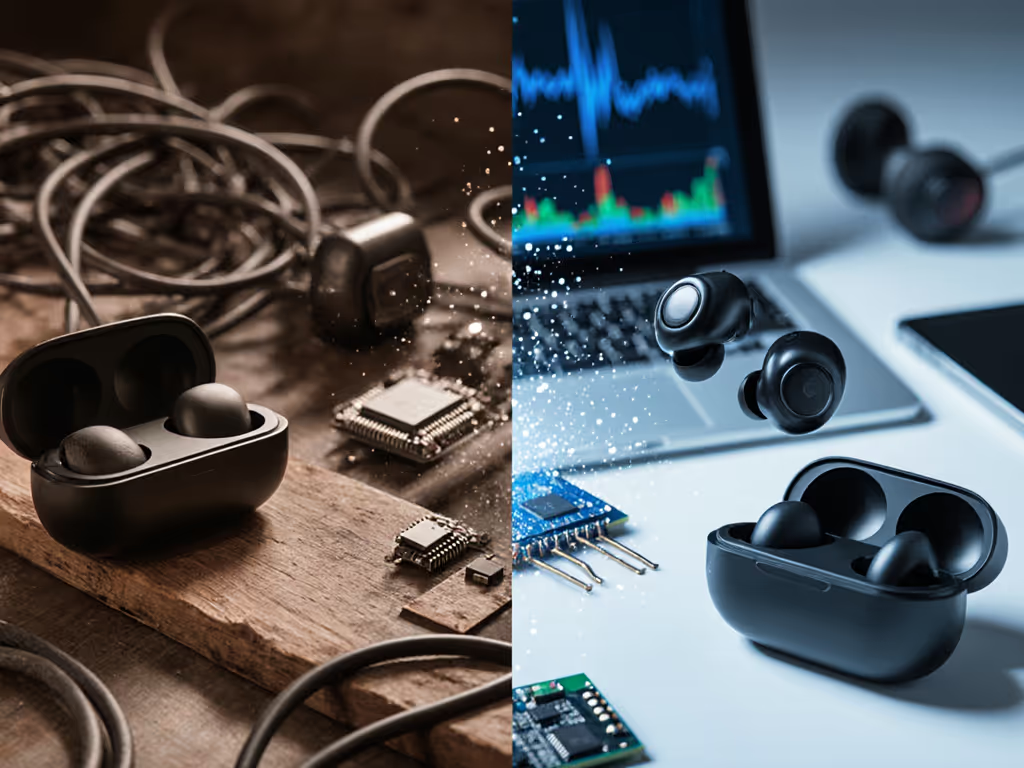
The wireless earbud technology evolution represents one of the most striking journeys in consumer audio, a shift from curiosity to necessity in under a decade. The history of true wireless earbuds is less a story of one breakthrough and more a cascade of small, deliberate engineering choices that converged to solve an old problem: how to deliver meaningful sound without a tether. But beneath the marketing narratives about active noise cancellation and AI-powered features lies a quieter truth that shapes everything you hear: fit writes the frequency plot before any EQ matters. Understanding this requires looking back at what earbuds were before they became what they are now.
What made early wireless earbuds so limited?
When truly wireless earbuds first entered the market around 2016, they were primarily engineered for one thing: freedom from cables. Early models sacrificed nearly everything else to achieve that aim. Battery life was measured in hours, not days. For what those numbers really mean in practice, see our battery life reality check. Audio quality was basic, and connectivity was often unreliable. The focus was on convenience, not performance.
This wasn't laziness on the part of manufacturers; it was the hard limit of miniaturization. Fitting a Bluetooth radio, a battery, a microphone, and a speaker driver into a device small enough to fit in your ear demanded ruthless prioritization. Sound quality wasn't the priority; portability was.
That changed when Apple introduced AirPods in 2015, and the wireless earbud segment transformed. Apple's innovation wasn't groundbreaking in isolation; rather, it was their integration of a dedicated Bluetooth chip (the W1) that made pairing seamless and reliable. More importantly, Apple normalized the form factor. What had been a niche category suddenly became aspirational. Competitors rushed in, and the market began to mature.
How did the technology infrastructure improve?
The real acceleration came from solving the Bluetooth problem. Early TWS earbuds struggled with pairing instability, audio dropout, and power inefficiency, not because designers weren't capable, but because the underlying wireless protocol wasn't optimized for symmetric, true-stereo devices.
Qualcomm's work on true wireless development made a measurable difference. Their aptX Adaptive codec and True Wireless Mirroring technology introduced dynamic role-switching, where either earbud could act as the "primary" device. This eliminated the asymmetry that had plagued earlier designs. Mono mode became practical, not just theoretical. When one earbud was removed, audio could hand off smoothly without dropout.
Simultaneously, miniaturized driver designs improved. Entry-level wireless earbud innovation accelerated as bill of materials costs dropped substantially. Brands that had never made audio products suddenly launched their own lines. By 2020, the baseline had shifted: passive isolation became standard, basic noise cancellation became expected, and longer battery life became table-stakes.
When did noise cancellation become mainstream?
Active noise cancellation was once a premium feature found only in over-ear studio headphones, shrouded by health concerns and astronomical pricing. Today, it's found in earbuds at every price tier, including sub-$100 models. For a deeper dive into how ANC actually works and its trade-offs, see our ANC technology explainer.
This shift reveals something important about how perceived tuning evolves. ANC doesn't just block external sound; it changes how the earbud couples to your ear canal. A poor seal undermines ANC effectiveness. I learned this viscerally in my own testing (in a studio quiet as snowfall). I swapped tips and watched the response curve smooth where a leak had carved a canyon. That moment clarified what I'd heard subjectively: a 2 dB dip at 400 Hz, a hollow midrange, energy concentrated in the treble. The culprit wasn't the driver; it was inadequate seal. Once the fit was right, EQ adjustments became meaningful. Without it, they were theater. This insight shaped how I approach recommendations: seal before EQ.
Consumer expectations now demand Adaptive Noise Cancellation, transparency mode, and wear detection as standard features. But the performance of all three hinges on a stable, predictable seal, a fact that often gets lost in spec-sheet comparisons.
What do modern earbuds actually do differently?
Today's earbuds are not simply audio playback devices; they're small, high-performance computers. Modern Bluetooth audio progression includes spatial audio, where sound remains fixed in space even as your head moves. Active noise cancellation now uses multiple microphones to listen to the world and create inverse soundwaves to cancel ambient noise.
More recent designs have added AI-powered adaptive sound, real-time language translation, and personalized EQ that adjusts based on your hearing patterns. Some models detect the type of content you're playing and optimize the audio accordingly. These features represent genuine advances, but they're all downstream of a fundamental prerequisite: reliable fit and seal.
What's the relationship between fit and perceived tuning?
This is where the narrative often diverges from lived experience. Reviewers frequently evaluate earbuds in a controlled lab setting, with perfect seal, optimal positioning, and sometimes even custom inserts. In real use (during your commute, at your desk, at the gym) fit degrades over time. A slight rotation, a bead of sweat, jaw movement while speaking, or a helmet strap pressing on the earbud can shift the seal by millimeters. That shift changes the acoustic load on the driver, which shifts the frequency response.
For listeners with asymmetric ears (a far larger population than marketing assumes), one side may never achieve the seal assumed in the review. The right earbud sounds full and warm; the left sounds thin and bright. The earbud isn't broken. The fit doesn't work for your anatomy. Swapping tip sizes, materials, or insertion depth often solves this faster than EQ adjustments ever could.
For your routine and anatomy, the right fit unlocks the sound the designer intended. Thermal comfort and pressure management matter equally to acoustics. An earbud that aches after 30 minutes of wear creates listening fatigue that no sound signature can overcome. Stability in motion (resistance to rotation during runs or gym sessions) determines whether your seal remains consistent or fragments with each stride.
What role has ecosystem lock-in played in the market?
Brands have increasingly used proprietary features to differentiate. Galaxy Buds Pro, for example, offer 360-degree audio and fast multi-device switching, but these features work best within Samsung's ecosystem. This isn't merely a business strategy; it reflects how wireless audio has become intertwined with the larger device ecosystem.
For users, the implication is that a pair of earbuds isn't a standalone purchase; it's a commitment to an ecosystem's conventions around Bluetooth behavior, app-based EQ, and firmware updates. This makes fit and comfort even more critical, because you'll be living with these devices across multiple contexts and years, not treating them as disposable.
Where is wireless earbud technology heading?
The next evolution won't be dominated by audio specifications alone. Components like 2-way audio modules now merge sound engineering with sensing technology, turning earbuds into multifunctional smart wearables. The line between audio devices and health tech is blurring: sensors for biometric monitoring, ambient pressure detection, and even spatial awareness are being integrated alongside drivers and microphones.
This trend brings fit into even sharper focus. A biometric sensor must contact your skin consistently to provide reliable data. That same seal requirement underpins both acoustics and sensing. The future of personal audio isn't about specs on a box; it's about devices that respect your anatomy, maintain that respect through hours of daily wear, and deliver both audio and utility as a unified experience.
How can you navigate this landscape as a buyer?
Given the maturation of the market, nearly every brand now offers some version of active noise cancellation, wireless charging, and water resistance. The real differentiation lies in factors rarely mentioned in promotional material: nozzle angle, shell geometry, tip ecosystem depth, and weight distribution. These variables determine whether an earbud will seal reliably in your ear, stay stable during motion, and feel comfortable at hour six of an eight-hour workday.
Before evaluating sound quality or feature sets, establish fit and comfort as your baseline. Our comfort and fit comparison breaks down tip options, shapes, and pressure relief designs across brands. Seek brands that offer multiple tip sizes and materials, not just S, M, L silicone, but shallow and deep insertion options, foam alternatives, and stability fins if your ear shape requires them. If you struggle with seal on one side, that's not an earbud flaw; it's a geometry mismatch. Changing your approach to fit often solves what EQ cannot.
The evolution of wireless earbud technology has given you unprecedented choice. But choice is only valuable if you understand which variables matter for your body, your routine, and your listening environment. Seal before EQ. Fit first. Then sound. That hierarchy hasn't changed, even as the underlying technology has become remarkably sophisticated.
Further Exploration
To deepen your understanding of what makes earbuds work for your ears specifically, explore how earbud engineering milestones like Bluetooth codec improvements and multi-driver designs have converged with fit science. Research how brands differ in their approach to tip variety and shell sizing. Most importantly, treat fit as your first diagnostic tool (not a checkbox). When sound disappoints, investigate seal before assuming the earbud is the problem. The history of wireless earbuds is a history of miniaturization and feature-stacking, but the future belongs to designs that honor individual anatomy as seriously as they pursue acoustic performance.
Related Articles