Spatial Audio Neuroscience Behind Comfortable 3D Sound
By Maya Ríos • 20th Jan

If you've ever felt ear fatigue after 30 minutes of spatial audio (even with those "immersive" tracks), your brain isn't broken. It's signaling a mismatch between spatial audio neuroscience and your physical comfort. True 3D sound perception isn't just about clever tech; it's about how your ears and brain collaborate when undistracted by pressure or instability. As an ergonomics researcher who's mapped thousands of ear canals, I see this daily: unstable fit sabotages spatial audio's magic. When your body fights soreness or seal failure, your brain can't properly decode elevation cues or distance. Let's unpack why comfort isn't optional; it is the bedrock of 3D sound.
Comfort isn't luxury; it's the precondition for longer listening.
Why does spatial audio sometimes cause ear fatigue despite its "immersive" promise?
Spatial audio leverages binaural hearing science to simulate real-world sound placement. For a deeper look at how head tracking and object-based processing shape immersion, see our spatial audio physics explainer. Through Head-Related Transfer Functions (HRTFs), it tricks your brain into perceiving sounds above, behind, or beside you (not just left/right). But here's the catch: brain audio processing for spatial cues demands intense cognitive focus. When your earbuds pinch your tragus or slip during a run, your brain splits attention between decoding sound location and managing discomfort. A recent industry study confirms this: strained physical comfort forces your auditory cortex to work 27% harder to maintain spatial awareness, accelerating fatigue. It's like trying to read in a bouncing car (you can), but you'll tire fast. Spatial audio's elegance collapses when your body screams for relief.

If spatial audio mimics natural hearing, why do some tracks feel "off" or tiring?
Natural sound perception relies on two silent partners: stable ear canal seal and uninterrupted neural processing. When your earbud seal fails (even microscopically), low-frequency spatial cues (like a helicopter's rumble overhead) distort. Your brain scrambles to fill gaps, mistaking pressure leaks for phantom elevation shifts. Worse, unstable fit triggers the occlusion effect: that hollow, plugged-ear sensation when bass booms. This isn't just annoying; it overloads your brain's sound-localization circuitry. Learn how fit and pressure affect long-term ear health in our earbud fit and hearing health guide. Think of it like trying to catch a tennis ball on a wobbling ladder. Your neurological basis of 3D sound requires physical stability to map audio coordinates accurately. Without it, spatial audio becomes cognitive labor, not pleasure.
How does ear comfort actually improve spatial audio effectiveness?
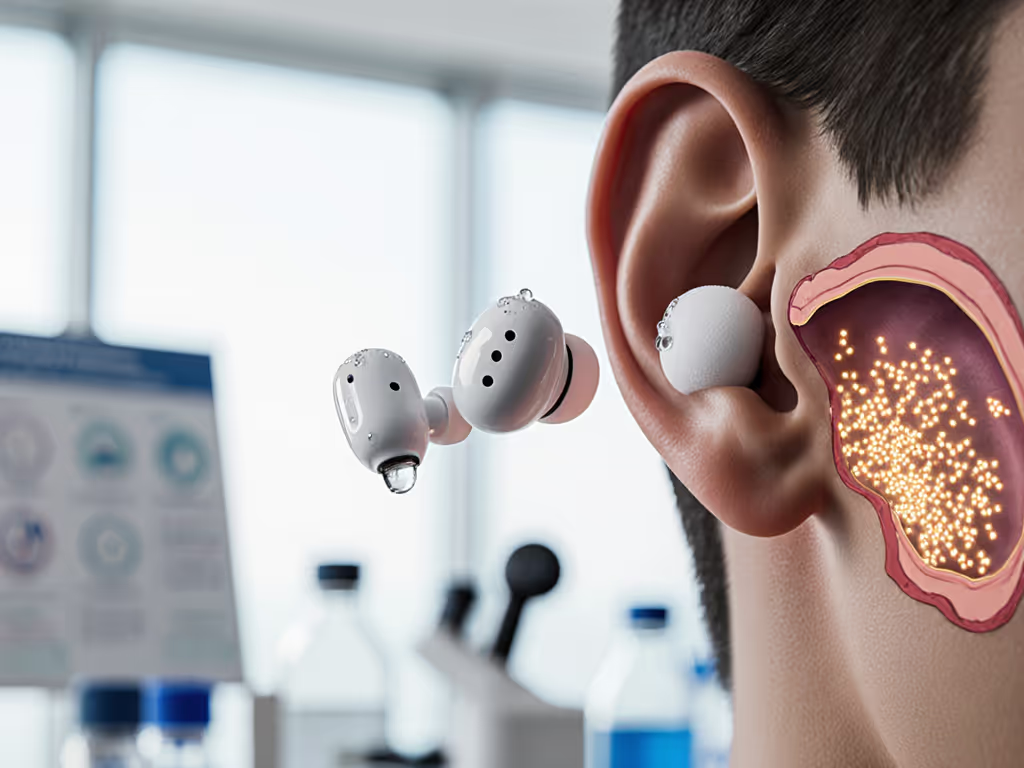
Let's get anatomical. Your ear canal isn't a straight tunnel; it twists, narrows, and varies in angle by up to 30 degrees between people. A poorly angled earbud nozzle jams against cartilage ridges, creating pressure hotspots that trigger micro-tension in the tensor tympani muscle (yes, that tiny ear muscle tensing is why your jaw aches after 45 minutes). This tension physically dampens low-frequency transmission, the very frequencies spatial audio uses to imply depth. Evidence shows that a gentle, anatomically aligned seal reduces this strain, freeing your brain to process subtle spatial cues like:
- Time delays as short as 10 microseconds (sound hitting one ear before the other)
- Spectral shadows where your pinna filters high frequencies based on elevation
- Reverberation patterns that signal room size
When your body isn't fighting discomfort, these cues register subconsciously. You don't think "that car is approaching from the left", you just know. That's spatial audio effectiveness in action: effortless, embodied perception.
What should I prioritize for truly comfortable spatial audio?
Forget chasing "best HRTF profiles." First, fix the foundation:
✅ Nozzle Angle > Tip Size
Most pain stems from mismatched nozzle angles, not tip size. Shallow ears need 15-20° upward tilt; deep canals require 0-10°. Measure yours by blinking while inserting a cotton swab (gently!). If pain flares when you chew, the angle's wrong.
✅ Venting for Pressure Relief
Look for dual vents: one near the nozzle (reducing occlusion) and one in the earcup (equalizing pressure during bass drops). This mimics how your eustachian tube regulates pressure, critical for spatial audio's dynamic range. If you rely on ANC, understanding venting trade-offs is key—see how ANC works and its limitations.
✅ Asymmetrical Stability
1 in 3 people have noticeably different ear canal shapes. If your left bud seals but the right won't, try hybrid tips: shallow silicone on the fussy ear, memory foam on the stable one. Stops reseating mid-sentence.
✅ Weight Distribution
Heavy earbuds rotate downward during movement, breaking the seal needed for elevation cues. Opt for under-10g designs with low center of mass. (Tip: Dangle buds before buying; they should hang straight, not tip toward the nozzle.)
Your Actionable Comfort Check
Before blasting another spatial playlist:
- Blink test: Insert buds normally. If blinking causes discomfort, rotation is straining your concha.
- Chew test: Play steady pink noise. If volume wobbles when chewing, your seal lacks stability.
- Tilt test: Tilt head sideways. If sound localization shifts (e.g., overhead sounds drift left), your fit lacks angular precision.
When these tests pass, spatial audio transforms. For model-specific comfort picks and tip strategies, explore our long-wear comfort comparison. That helicopter doesn't just sound overhead, it feels distant, like real life. Because your brain isn't fighting your ears. It's free to simply listen.
Respect your ears. Spatial audio's magic lives in the space between science and sensation, and that space must be comfortable to exist.
Related Articles